
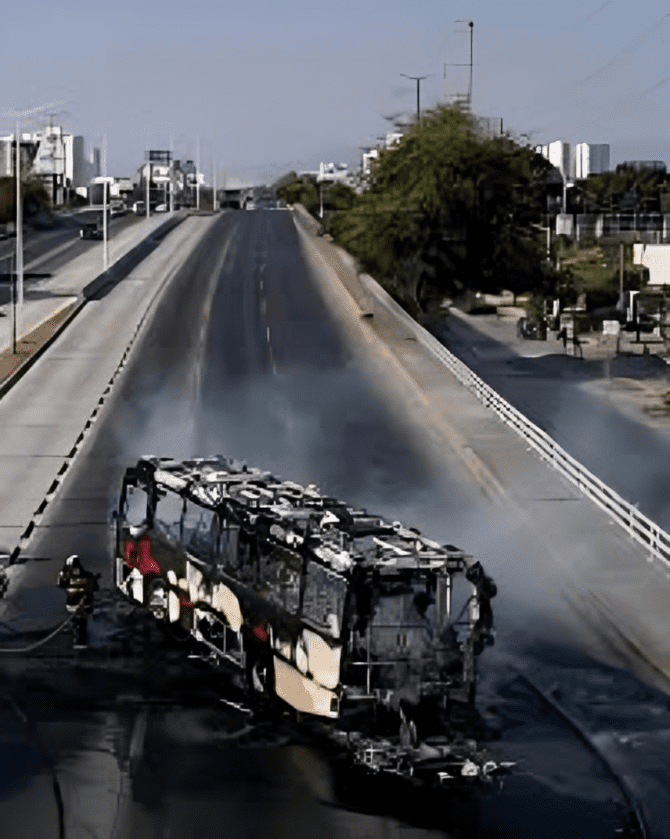
The killing of notorious Mexican drug lord Nemesio Oseguera, also known as El Mencho, has led to widespread cartel retaliation across several Mexican states. The Sunday military raid that eliminated El Mencho, head of the Jalisco New Generation Cartel (CJNG), prompted an immediate surge in violent attacks. Gunmen loyal to the cartel blocked highways, set vehicles and businesses on fire, and spread chaos as authorities scrambled to regain control.
What Happened?
After El Mencho was killed in a high-profile military operation:
- Armed cartel members launched coordinated attacks across multiple states.
- Key highways were blocked using burning vehicles and barricades.
- Businesses were targeted and set ablaze, causing economic disruptions.
- Civilians were forced to flee or remain indoors amid shootouts.
Officials described the situation as “highly organized retaliation” designed to destabilize government control and assert the cartel’s remaining influence.
Who Was El Mencho?
El Mencho, considered one of the most dangerous criminals in Mexico, led the CJNG, which operates:
- Large-scale drug trafficking networks
- Firearms and weapons smuggling operations
- Extortion and kidnapping schemes
- High-intensity armed confrontations with law enforcement
His death leaves a power vacuum, sparking fears of infighting among CJNG factions and further violent escalation.
How Retaliation Unfolded
Cartel retaliation was executed rapidly, showing a high level of coordination:
- Checkpoints established on highways to impede security forces.
- Vehicles set on fire to create chaos and hinder response.
- Arson attacks on businesses to intimidate local communities.
- Randomized gunfire reported in urban areas.
These attacks suggest the cartel retains operational capability even after losing its leader, highlighting ongoing security risks.
Response from Authorities
Mexican officials deployed military and police forces to affected areas:
- Additional patrols on highways and major thoroughfares.
- Firefighters dispatched to control arson incidents.
- Security alerts issued for residents in high-risk areas.
Authorities emphasized that intelligence operations are ongoing to track cartel operatives and prevent further escalation.
Social and Economic Impact
The retaliation has significant consequences:
- Civilian Safety: Schools, hospitals, and homes were temporarily evacuated in high-risk zones.
- Economic Disruption: Businesses lost revenue due to arson and closures.
- Transportation Halted: Highway blockages disrupted trade and logistics.
Communities have expressed concern about prolonged violence and its effect on daily life and livelihoods.
Expert Analysis
Security analysts say that El Mencho’s death and subsequent retaliation are typical of cartel dynamics:
- Leadership eliminations often trigger violent power struggles.
- Coordinated attacks are a show of strength and warning to rivals.
- The CJNG remains capable of widespread disruption despite losing its top figure.
Experts also highlight that these events could influence regional security policy and law enforcement strategies in Mexico.
International Attention
The U.S. and other countries monitoring drug cartels have expressed concern over the rapid escalation of violence. The CJNG is known to have international operations, making El Mencho’s death and retaliation significant beyond Mexico’s borders.
What Happens Next?
Authorities expect:
- Potential succession disputes within CJNG factions.
- Heightened military and police presence in affected areas.
- Continuation of strategic operations to capture or neutralize cartel leaders.
Residents are advised to stay alert, avoid conflict zones, and follow official guidance.
Conclusion
El Mencho’s death has sparked immediate cartel retaliation, demonstrating the enduring power and threat posed by criminal networks in Mexico. The attacks underline the challenges law enforcement faces in dismantling entrenched organizations and protecting civilians. While military operations continue, authorities and communities must prepare for a period of heightened volatility and strategic responses to restore stability.