South Africa’s executive has left the country at a decisive moment for local governance. President Cyril Ramaphosa has flown to California with nine ministers and a delegation of 300 people, including 27 students and business sector leaders, at the exact point when coalition negotiations will determine who governs municipalities, how services are delivered and whether communities will see any improvement. The stated purpose is not to fix water, electricity, roads or municipal failure, but to court the United States for artificial intelligence expertise, investment and technology.
The composition of the travelling party is itself a governance question. Among the nine ministers are the office-holders responsible for finance, international relations and cooperation, trade, industry and competition, communications and digital technologies, electricity and energy, science, technology and innovation, and small business development, along with the minister in the Presidency and South Africa’s ambassador to the US. These are not ceremonial appointments. They are the people charged with the economy, trade, energy, telecommunications, regulation and public investment, and their absence coincides with an attempt to form governments after an election that fractured the political landscape.
Additional reference context is available at https://www.dailymaverick.co.za/opinionista/2026-11-21-a-luxurious-silicon-valley-trip-cannot-fix-what-the-south-african-government-has-broken-at-home/.
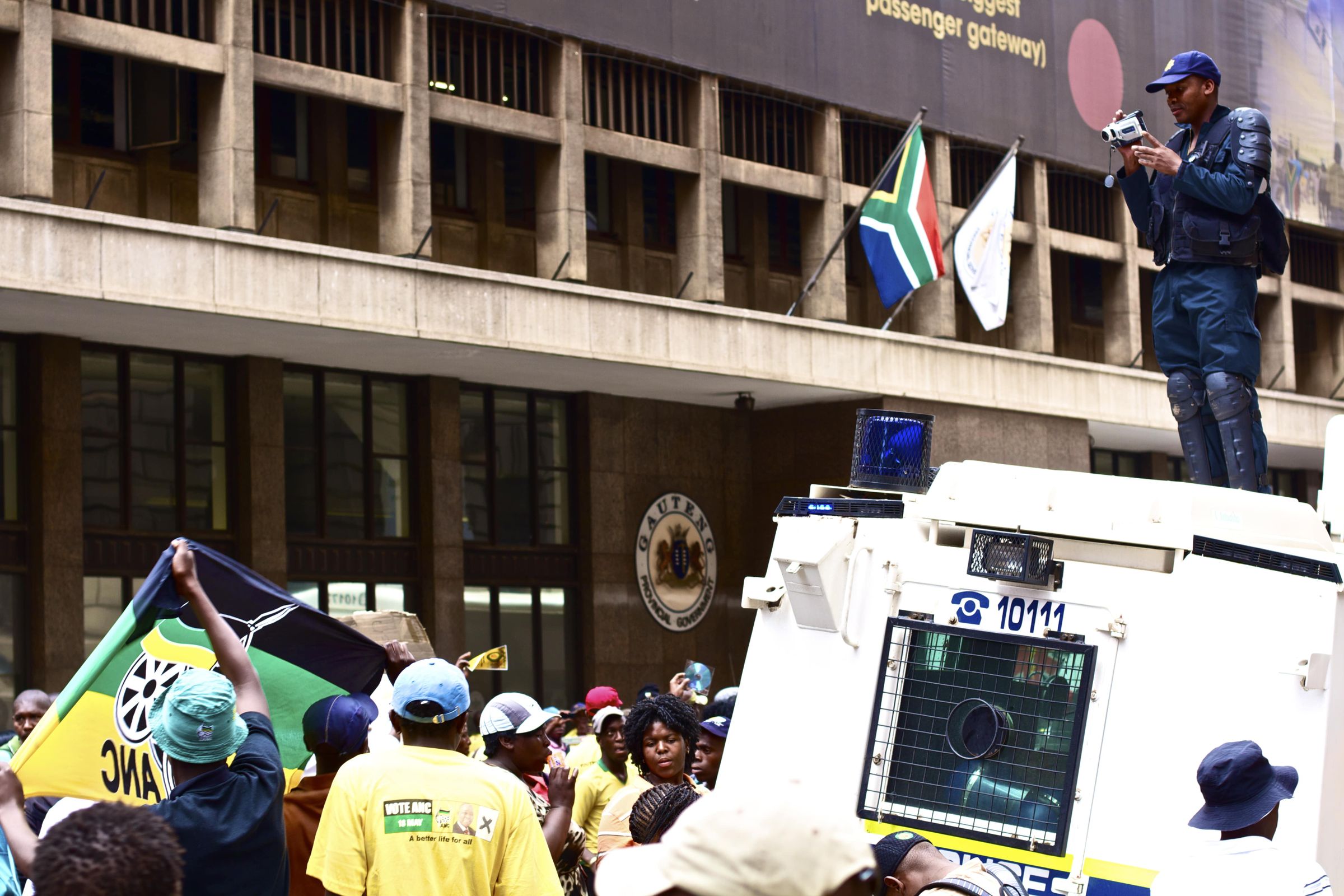
That election delivered one of the African National Congress’s worst results in its history. The party received 30.89% nationally, its worst local election outcome, and lost control of most municipalities it had held after 2021. Voters punished it over failing taps, unreliable power, potholes, sewage, crime and collapsing municipalities. The accountability question is straightforward: an electorate has rendered its verdict on the state’s performance, and the President’s response is not an emergency plan to stabilise local government but a high-profile trip to Silicon Valley, in search of partnerships with a country his government has spent years publicly confronting, criticising and distancing itself from.
The Presidency describes the visit as a “high-level learning visit” intended to help South Africa understand the global AI ecosystem and identify opportunities for investment, innovation and collaboration. But learning visits do not build data centres. Relationship-building does not keep the lights on. A promise to identify “practical initiatives” within 90 days is not the same as a signed investment agreement. There is nothing inherently wrong with seeking investment; South Africa needs capital, technology, jobs and skills. The timing, composition and message of the trip, however, expose a government that appears more interested in global symbolism than in the basic work of governing.
Meanwhile, the trip lands at a moment when the country’s trade relationship with Washington is under severe strain. The US has notified Congress of its intention to suspend South Africa’s participation in the African Growth and Opportunity Act (Agoa) from 1 January 2027. Agoa is not a small technical programme. It has given eligible African countries duty-free access to the US for thousands of products, supporting exports, factories, jobs and supply chains. Losing it means losing preferential access to one of the world’s largest consumer markets. Once that access ends, South African exporters will have to negotiate ordinary trading terms: tariffs, quotas, compliance costs and bargaining from a weaker position. The consequences will be felt not only in boardrooms but in factories, farms, logistics companies, ports and households, and investors may see another reason to question whether South Africa is a predictable place to do business. At the very moment Agoa is being taken away, the President travels to the US to ask for investment. That is not strategy; it is damage control dressed up as diplomacy.
The contradictions run deeper than timing. Science, Technology and Innovation Minister Blade Nzimande, a longstanding leader of the South African Communist Party, is part of the delegation. The SACP has historically defined itself against capitalism, private accumulation, monopoly capital, financialisation and what it calls imperialist influence. Silicon Valley, however, is the global headquarters of venture capital, private ownership, intellectual property, stock market wealth and corporate power, the most visible expression of the system the party has spent decades criticising. If the ANC and its allies believe capitalism is the problem, the trip raises an uncomfortable question about why they are travelling to the world’s leading capitalist technology hub to seek solutions from capitalist investors. Pragmatism may be the answer, but then the government should stop presenting anti-capitalist rhetoric as a serious economic strategy. It cannot condemn monopoly capital at home and then ask monopoly capital for funding abroad.
International Relations and Cooperation Minister Ronald Lamola presents a similar test of consistency. His department has accused Washington of unilateralism, misinformation and propaganda, rejected American criticism of South African policy, described US actions as unacceptable, and condemned the US and Israel for military action against Iran, saying their conduct violated the United Nations Charter. A sovereign country is entitled to an independent foreign policy, but diplomacy requires consistency. If the US is a strategic partner, it should be treated like one; if it is an adversary, South Africa should not be asking it for investment, technology and market access.
The same tension surrounds BRICS. As a founding member of a bloc that has positioned itself as a challenge to Western economic dominance and to the global influence of the US dollar, South Africa now seeks American capital, technology, research partnerships and market access. It cannot present itself as part of an anti-Western bloc while expecting the US to treat it as a close economic partner.
Then there is Elon Musk. Ramaphosa has used the trip to challenge Musk directly, saying he should remember South Africa and be loyal to the country of his birth. Musk has rejected that framing. The loyalty argument is extraordinary coming from a party that has governed for decades while presiding over deteriorating infrastructure, failing municipalities, unemployment, crime and declining public services. Musk is not the reason the ANC lost support, municipalities are failing or infrastructure has decayed. Loyalty is measured by whether the state does its job for its people.
Suppose Ramaphosa returns with promises, meetings and expressions of interest. That investment must still come home to a country that can host it. Data centres need reliable electricity. Factories need water, roads, ports and logistics. Technology companies need fibre, skilled workers, stable regulation and confidence that policy will not change overnight. Municipal water systems are failing, electricity supply remains fragile, and roads, rail, ports and public services have deteriorated. South Africa does not need another overseas trip to understand that. It needs a government that stays home, fixes the basics, gives investors certainty, restores infrastructure and treats its own citizens with the same loyalty it demands from everyone else. Whether the 90-day promise of practical initiatives produces anything more than symbolism remains the open question.